
I tried three free AI maturity assessments. Here's what I found.
Three online tools, three radar charts, three nudges towards adoption. None of them allowed for the answer 'don't do this yet' — which is the answer SMEs need most.
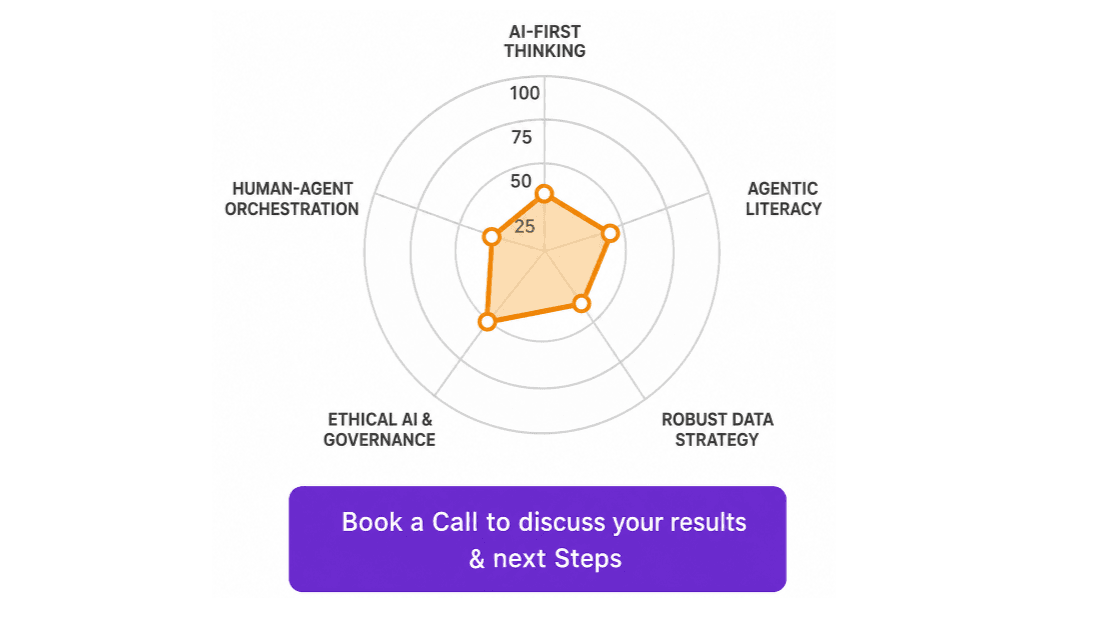
The volume of online AI maturity assessments appearing in my feeds in the past couple of months piqued my curiosity and prompted me to take a closer look.
Their proposition was consistent. A short set of multiple-choice questions would generate a view of where a business sits on its AI journey, followed by a suggested set of next steps. I wanted to better understand this idea, where a brief, automated questionnaire could provide meaningful insight into how a business should approach AI.
Each assessment followed a similar structure. A standardised set of around 12 to 15 questions, covering areas such as current use of AI, data availability, internal capability, governance, and future ambitions. As far as I could tell, none of the questions adapted based on previous responses, and there was no attempt to reflect the specifics of the business being assessed. The same set of questions would be applied to a small professional services firm, a manufacturer, or a retailer, without any change.
The output arrived as a PDF report within minutes of completion. The format appeared consistent across the examples I tested. A visual summary, typically a radar chart, scoring the business across five abstract dimensions (AI-First Thinking, Agentic Literacy, Human-Agent Orchestration, Ethical AI & Governance, and Robust Data Strategy), followed by a set of recommendations and a prompt to take the next step.
By the third assessment, a clear pattern had emerged. The scoring dimensions appeared to be abstract by design. In practice, most businesses are likely to score relatively low in at least one or two areas, regardless of how they actually operated. That in itself is not necessarily wrong, but to me it indicated that the report was broad rather than specific.
The recommendations that followed were framed as a progression towards adopting AI. Even where gaps were identified, the output tended to move towards implementation, often supported by staged plans, indicative budgets, and projected efficiency gains.
From an operational perspective, this 'assessment model as a sales funnel' is operationally very clean. A lean organisation can build the questionnaire, automate the reporting, and run it at scale. There is no need for detailed engagement with the business itself.
Based on what I saw, I decided to build an alternative approach. The resultant audit I've developed is workshop-led and works through the business function by function. By that, I mean looking at how specific pieces of work are actually carried out. For example, handling a sales enquiry, responding to a customer complaint, chasing late payments, or managing a supply issue.
I made a deliberate decision not to produce an overall score or maturity rating. I also chose not to benchmark one business against another, as I couldn't see how such a comparison would add any real value. Instead, the focus is on making a clear decision for each function.
For every area reviewed, the outcome sits in one of four categories: Quick Win, Bigger Build, Fix First, or Not Yet. That structure is intentional. It allows for outcomes where AI is not the immediate answer.
None of the off-the-shelf assessments I tested appeared to allow for this. They assumed that AI is the intervention and structure the output around that assumption. Even where gaps are identified, the result is usually framed as a sequence of steps towards eventual deployment, rather than a decision to wait.
In my eyes an objective audit needs to allow for a different conclusion. In some cases, the right course of action is to improve data quality, connect systems, or stabilise a process before introducing AI. Only once those areas are in a better state does it make sense to revisit it.
Then there's the matter of specificity. The fixed questionnaires I encountered couldn't capture how systems, processes and people interact inside a business. Those relationships often determine whether an AI approach will work in practice.
Ownership is another factor. For an AI pilot to succeed in an SME, someone needs to take responsibility for it. That person needs the time and authority to keep the work moving. Without that, even a well-defined initiative will probably stall. This is not something a short assessment will surface. It usually comes out through discussion with the leadership team. In many cases, the practical constraint is simple: there is only enough capacity to run one meaningful pilot at a time.
There is a similar issue in how problems are interpreted. If a process is inconsistent, or if data is spread across multiple systems, the problem is not necessarily an AI problem. In those situations, adding AI on top may well make things worse rather than better.
An assessment tool built around AI readiness will tend to push towards an AI-shaped answer regardless. That does not make these assessments useless. If you are curious, spending ten minutes completing one can be a reasonable way to see how the topic is being framed. However, I would question whether it creates enough of an understanding of your own business to provide actionable insights. If you are deciding about where AI should sit in your organisation, then a more detailed look at how your core business functions currently run is likely to be a more useful starting point.
Lastly, if you are choosing where AI fits in your business, then the test for any audit is a simple one. Can it tell you not to do it? If the answer is no, then the audit is selling AI, not assessing whether you need it.